What is buttress? Pronunciation and usage in English

buttress means . Learn how to pronounce and use buttress through vivid examples and easy-to-understand exercises.

Definition & pronunciation of buttress

buttressnoun

/ˈbʌtrəs//ˈbʌtrəs/
Definition & pronunciation of buttress

Okay, let's break down how to pronounce "buttress" in English. It can be tricky for some people! Here's a breakdown:

1. The Core Sounds:

  • "But-": This part sounds like "butt" – like the word "butt" (as in on your bottom).
  • "tress": This part is the key tricky part! It's pronounced like "tress" as in "dress" or "press." It’s not like “trust.”

2. Putting it Together - The Full Pronunciation:

The whole word is pronounced something like: "but-tress"

Let's break it down with emphasis:

  • “but” - Say it with a clear “t” sound.
  • “tress” - Say this with a short “e” sound, like in “dress.” It's a quick, short vowel sound.

3. A little more detail:

  • Stress: The stress is on the first syllable: "but-tress".

4. Resources to Listen:

Tips for Practicing:

  • Say it slowly at first: Focus on getting the "but" and the "tress" separate.
  • Repeat: Listen to the audio examples and repeat after them several times.
  • Record yourself: This can help you hear where you might be going wrong.

Would you like me to:

  • Repeat the pronunciation slowly?
  • Give you some example sentences to practice with?

Usage and examples with the word buttress in English

Let's break down how to use the word "buttress" effectively in English. It's a surprisingly versatile word with a few different meanings, so understanding those nuances is key.

1. Primarily: A Structural Support (The Most Common Meaning)

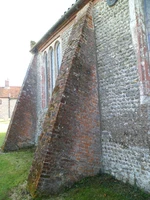
  • Definition: A buttress is a projecting piece of masonry or timber that provides support to a wall, arch, or other structure. Think of it as a reinforcing wall.
  • Example: "The ancient castle relied on massive buttresses to withstand the force of the winds."
  • Synonyms: support, reinforcement, brace, pillar.

2. Figuratively: To Support or Strengthen (A Key Usage)

This is where "buttress" gets interesting. It means to provide support, encouragement, or reassurance to someone. It's about bolstering them against difficulties.

  • Definition: To reinforce, strengthen, or support emotionally or mentally.
  • Example 1: "His encouraging words helped to buttress my confidence after the failed interview." (He gave me support to believe in myself.)
  • Example 2: “The successful project buttressed her application for a promotion.” (It added strength to her case.)
  • Example 3: “Her family is a strong buttress against her anxieties.” (They provide stability and help her cope.)
  • Synonyms: bolster, strengthen, reinforce, prop up, support, encourage.

3. Less Common Usage: A Raised Foundation

  • Definition: In construction, it can refer to a raised foundation under a structure, particularly for a bridge or building.
  • Example: "The bridge was built on a series of buttresses to raise it above the flood plain."

Tips for Using "Buttress" Correctly:

  • Context is crucial: Pay attention to the sentence and the overall topic to determine which meaning is intended. Is it about a physical building, or someone's emotional state?
  • Formal tone: "Buttress" lends itself to a more formal writing style. It's less common in everyday conversation.
  • Figurative is powerful: When used figuratively, it conveys a sense of solid, reliable support.

Here's a quick summary table:

Meaning Example
Structural Support “The stone wall had impressive buttresses.”
Emotional Support “His belief in me helped buttress my resolve.”
Foundation “The building rested on buttressed piers.”

Resources for Further Learning:

Do you want me to:

  • Give you more examples of “buttress” used in different ways?
  • Provide a practice exercise where you need to choose the correct meaning?
  • Explain how “buttress” is used in a specific sentence or context?

Practice with vocabulary buttress

Exercise 1: Fill in the blanks

  1. The historic building's vulnerable facade required the addition of steel frames to adequately ________ it against further decay.
  2. Experts provided ample evidence to ________ the controversial new policy, arguing for its long-term benefits.
  3. The company decided to ________ its market position by acquiring a smaller competitor and streamlining operations.
  4. Effective communication among team members will ultimately ________ the successful execution of the complex project.

Exercise 2: Choose the correct answer

  1. Which of the following actions best illustrates the verb to "buttress"? a) Providing scientific data to support a new theory. b) Adding structural reinforcements to a crumbling wall. c) Criticizing a flawed argument in a debate. d) Presenting a detailed financial report to investors.

  2. In which of these contexts would "buttress" be an appropriate term? a) Describing a psychological defense mechanism. b) Explaining the function of external architectural supports. c) Characterizing efforts to strengthen a legal precedent. d) Detailing the process of dismantling an old machine.

  3. The company sought to "buttress" its market position. Which strategies might achieve this? a) Diversifying its product line. b) Launching aggressive advertising campaigns. c) Expanding into new geographical markets. d) Acquiring smaller competitors.

  4. Which word is the most appropriate synonym for "bolster" in the context of supporting an argument? a) Undermine b) Corroborate c) Contradict d) Disprove

  5. To "mitigate" a risk means to: a) Exacerbate it b) Lessen its severity c) Ignore its existence d) Amplify its impact

Exercise 3: Rewrite the sentences

  1. The legal team presented compelling historical data to provide strong support for their client's claim.
  2. The historic church was famous for the large, sloping supports that projected from its exterior walls, giving it immense strength.
  3. The comprehensive investigation served to firmly confirm the initial findings, leaving no room for doubt.

Answer:

Exercise 1: Fill in the blanks

  1. buttress
  2. buttress
  3. consolidate
  4. underpin

Exercise 2: Choose the correct answer

  1. a) Providing scientific data to support a new theory. b) Adding structural reinforcements to a crumbling wall.
  2. b) Explaining the function of external architectural supports. c) Characterizing efforts to strengthen a legal precedent.
  3. a) Diversifying its product line. b) Launching aggressive advertising campaigns. c) Expanding into new geographical markets. d) Acquiring smaller competitors.
  4. b) Corroborate
  5. b) Lessen its severity

Exercise 3: Rewrite the sentences

  1. The legal team presented compelling historical data to buttress their client's claim.
  2. The historic church was famous for its large, sloping exterior buttresses, which gave it immense strength.
  3. The comprehensive investigation served to firmly substantiate the initial findings, leaving no room for doubt.

Comment ()