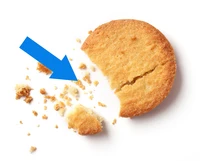
What is crumb? Pronunciation and usage in English

crumb means . Learn how to pronounce and use crumb through vivid examples and easy-to-understand exercises.

Definition & pronunciation of crumb

crumbnoun

/krʌm//krʌm/
Definition & pronunciation of crumb

Okay, let's break down how to pronounce "crumb." It's a tricky one because it's a common mispronunciation! Here's how it's actually said:

The correct pronunciation is: /krʌm/

Let's break it down further:

  • "kr" - This is a short, quick "kr" sound, like in "crack." Don't overemphasize it.
  • "ʌm" - This is the key part! It's a short, open "uh" sound (like the "u" in "but") followed by a very short "m" sound. It’s almost like you're saying “crum.”

Here's a helpful breakdown:

  1. Start with a quick "kr" sound.
  2. Immediately follow it with a short, relaxed "uh" sound (like in "but").
  3. Quickly add the "m" sound.

Listen to examples:

Common Mistakes & Why They're Wrong:

  • "crum" (as in "cr-um"): This is the most common mistake. It adds a drawn-out vowel sound that doesn't exist.
  • "crumb" with a long "u" sound: It's not a long "uh" sound. It's a very short, quick one.

Would you like me to:

  • Say it again slowly?
  • Give you some practice words to say with the same sound?

Usage and examples with the word crumb in English

Let's break down how to use the word "crumb" in English. It's a surprisingly versatile word with a few distinct meanings and ways to use it.

1. Literal Meaning: A Small Piece of Food

  • Definition: This is the most common meaning. A crumb is a tiny fragment or piece of something edible, usually bread, cake, or cookie.
  • Examples:
    • “He dropped a crumb on the tablecloth."
    • "She swept up the crumbs after the children ate their cookies."
    • "The bakery was famous for its fluffy brioche and the generous crumbs it left behind."

2. Figurative Meaning: A Remnant, Trace, or Hint

This is where “crumb” gets more interesting. It refers to a small remaining piece of something that suggests a larger thing. It represents a trace or indication.

  • Examples:
    • "The interview yielded only a crumb of information about her past." (Meaning: a tiny, insufficient piece of information)
    • “A single crumb of evidence suggested that he was lying.” (Meaning: a small, potentially significant hint)
    • “The detective searched for a crumb of information that could lead them to the suspect.”
    • "His words were just a crumb of truth amidst a web of lies."

3. As a Verb (Less Common): To Leave Small Pieces Behind

  • Definition: To leave small fragments behind, often after eating or handling something.
  • Example: “The dog crumbed his biscuit all over the rug.” (Meaning: left crumbs behind)

Here's a breakdown of nuances and usage tips:

  • Tone: “Crumb” often carries a slightly negative connotation when used figuratively. It suggests something small, incomplete, or perhaps even disappointing.
  • Imagery: The word evokes the image of something small, fragile, and easily overlooked.
  • Synonyms (for the literal meaning): fragment, piece, morsel, bit
  • Synonyms (for the figurative meaning): trace, hint, remnant, sign, vestige, clue

Let's test your understanding with some scenarios:

  1. You're examining a very old manuscript and find a tiny, faded piece of paper tucked inside. Would you describe it as a “crumb”? (Yes, as a remnant of the manuscript's history.)

  2. You’re interviewing a witness to a crime, and they only offer a vague, unhelpful statement. Would you say they "crumbed" information? (Yes – implying they left behind only a tiny, useless piece of information.)


Do you want me to:

  • Give you more examples of how to use "crumb" in different contexts?
  • Explain how the figurative meaning of "crumb" relates to other concepts like evidence or clues?
  • Provide a quiz to test your understanding?

Idioms of the word crumb

have/want none of something
to refuse to accept something
  • I offered to pay but he was having none of it.
  • They pretended to be enthusiastic about my work but then suddenly decided they wanted none of it.
none but
(literary)only
  • None but he knew the truth.
none the less
despite this fact
    none other than
    used to emphasize who or what somebody/something is, when this is surprising
    • Her first customer was none other than Mrs Obama.

    Comment ()