
English vocabulary and phrases on Mid-Autumn Festival








hen means . Learn how to pronounce and use hen through vivid examples and easy-to-understand exercises.
 /hɛn/
/hɛn/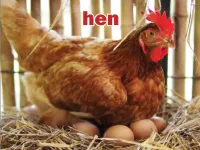
The word "hen" is pronounced hen (rhymes with "ten").
It's a very simple, short vowel sound: /hɛn/.
Here's a breakdown:
You can hear it pronounced here: https://www.pronounce.com/hen/
Do you want me to give you some example sentences using the word "hen"?
Let's break down how to use the word "hen." It's a surprisingly nuanced word with a few different meanings and uses! Here's a breakdown:
"Henpecked": This is a common phrase derived from the "hen" meaning. It describes a man who is dominated by his wife; he's "pecking around" for her approval.
Describing Someone Passive or Submissive: Sometimes, "hen" can be used metaphorically to describe a person who is very quiet, obedient, and easily led. (Again, be mindful of the potential for offense if used directly at someone.)
Important Considerations & Why You Should Be Careful
Resources for More Information:
To help me give you even more tailored advice, could you tell me:
Which of these terms specifically refers to an adult female chicken that lays eggs? A) Pullet B) Cockerel C) Hen D) Broiler
In commercial egg production, the primary bird raised for its output is the _______. A) Duck B) Goose C) Hen D) Turkey
The term "broody" is most commonly used to describe which of the following animals when it sits on eggs to hatch them? A) A male duck B) A female rabbit C) A female chicken D) A male goose
A young bird that has recently hatched and is still in its downy stage is known as a _______. A) Fledgling B) Chick C) Gosling D) Poult
What is the general term for domesticated birds kept for eggs or meat, such as chickens, ducks, and geese? A) Livestock B) Poultry C) Game D) Avian
Original: The female chicken is known for its strong maternal instincts, often protecting its young fiercely. Rewrite using "hen" or a related form:
Original: Farmers who aim to produce a high volume of eggs primarily keep female laying birds. Rewrite using "hen" or a related form:
Original: During the avian flu outbreak, all bird populations on commercial farms were closely monitored. Rewrite without using "hen" (use a suitable replacement word):
Exercise 1: Fill in the blanks
Exercise 2: Choose the correct answer
Exercise 3: Rewrite the sentences
English vocabulary and phrases on Mid-Autumn Festival

Tips to improve vocabulary in communication

English vocabulary by topic: Clothes

The secret to remembering all 50 English vocabulary words every day easily

English vocabulary by topic: Human body

Vocabulary of the most popular subjects in English

Learn English about Covid: All about vocabulary and disease prevention

Vocabulary of Subjects in English

Set of 60 English vocabulary on educational topics

Vocabulary - just a small thing!
Comment ()