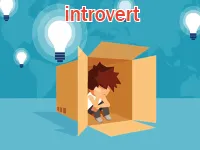
What is introvert? Pronunciation and usage in English

introvert means . Learn how to pronounce and use introvert through vivid examples and easy-to-understand exercises.

Definition & pronunciation of introvert

introvertnoun

/ˈɪntrəvəːt/
Definition & pronunciation of introvert

Okay, let's break down how to pronounce "introvert" in English. Here's a step-by-step guide:

  1. in-: This part sounds like "in" as in "in a box." It's a short, quick vowel sound.

  2. tro-: This part sounds like "tro" as in "trophies" (but shorter). It’s a single syllable.

  3. vert: This is the trickiest part. It sounds like "ver" as in "verb" followed by "t". Important: The "v" starts with a "v" sound, not an "i" sound.

Putting it all together:

It sounds like: in-tro-vert

Here’s a breakdown with emphasis:

  • in- (short "in" sound)
  • tro- (like "tro-phies" but shorter)
  • vert (sounds like “ver-t”)

Resources for Hearing it:

Tips:

  • Don't overemphasize each syllable. It’s a fairly smooth flow.
  • Practice slowly at first. Focus on getting the "vert" sound correct.

Would you like me to break down any part of the pronunciation further, or perhaps give you some example sentences to practice with?

Usage and examples with the word introvert in English

Let's break down how to use the word "introvert" effectively in English. It's a common word, but it's often misunderstood.

1. What Does "Introvert" Mean?

  • Core Definition: An introvert is a person who tends to gain energy from spending time alone or in small, quiet groups. They recharge by being alone, rather than by being around a lot of people.
  • Important Distinction: Introversion is not shyness. Shyness is a fear of social judgment. Introverts can be social, but they need time alone afterward to recover.
  • Key Traits: Introverts often:
    • Enjoy deep, meaningful conversations.
    • Prefer thoughtful reflection over constant social activity.
    • Might be uncomfortable with small talk.
    • Feel drained by large crowds.

2. How to Use "Introvert" in Sentences

Here are some examples, categorized for clarity:

  • Describing Someone:

    • "Sarah is an introvert; she loves to read and spend her weekends by herself."
    • "As an introvert, John finds it overwhelming to go to large parties."
    • "Don't be surprised if Emily seems quiet – she's just an introvert recharging her batteries."
    • "He's a really thoughtful introvert, always taking the time to consider his words."
  • Explaining Preferences:

    • “I need some time alone to be an introvert. I need to recharge before socializing.”
    • “I prefer smaller gatherings because I'm an introvert.”
    • "Being an introvert, I find it easier to focus when I'm in a quiet environment.”
  • Talking About Personality:

    • “Introversion is a normal and valuable personality trait.”
    • “It’s important to respect people’s introversion; everyone has different needs.”
  • In Response to a Question:

    • "When people ask me about it, I say I'm an introvert – I get energy from being alone."
    • “Yes, I’m an introvert. It just means I’m more comfortable with a few close friends than a huge crowd.”

3. Important Notes & Related Words

  • Extrovert: The opposite of an introvert. Extroverts gain energy from social interaction.
  • Ambivert: A person who falls somewhere in between introversion and extroversion – they can adapt to both social and solitary situations.
  • Introceptive: This is a more specific term related to how introverts experience the world. It refers to their heightened awareness of their internal sensations and feelings.

4. Common Mistakes to Avoid

  • Using "introvert" as a synonym for "shy." (Remember, they're not the same).
  • Assuming all introverts hate socializing. Many enjoy socializing, just in smaller doses and with people they trust.
  • Judging someone for being an introvert. It's simply a different way of experiencing the world.

Resources for Further Learning:

Do you want me to:

  • Give you more examples of how to use "introvert"?
  • Explain a specific aspect of introversion in more detail (e.g., how it affects communication)?
  • Help you practice using the word in a conversation?

Practice with vocabulary introvert

Exercise 1: Fill in the blanks

  1. Many find that spending a quiet evening reading at home helps them to recharge, a common trait for an ___________________.
  2. Despite being perceived as aloof, an ___________________ often possesses a rich inner world and strong observational skills.
  3. The candidate's ___________________ answers during the interview suggested a thoughtful but hesitant approach.
  4. His ability to charm large crowds and network effortlessly marks him as a truly ___________________ individual.

Exercise 2: Choose the correct answer

  1. Which of the following traits are commonly associated with an individual who finds energy in solitude and quiet reflection? a) enjoys large social gatherings b) recharges through alone time c) prefers deep, meaningful conversations d) seeks constant external stimulation e) is often an introvert

  2. A person who processes thoughts internally before speaking and may find small talk draining could be described as: a) an introvert b) highly adaptable c) a contemplative thinker d) an outgoing personality e) prone to social anxiety

  3. In a team meeting, who is most likely to listen carefully to all viewpoints before offering a concise, well-thought-out opinion? a) a natural leader b) an extrovert c) a person with introverted tendencies d) someone seeking the spotlight e) a reserved individual

  4. If someone is reluctant to speak or express themselves openly, often due to a lack of confidence in social situations, they might be considered: a) assertive b) shy c) self-assured d) timid e) quiet

  5. Which words best describe someone who thrives on social interaction, is often the life of the party, and gains energy from being around others? a) gregarious b) reclusive c) outgoing d) reserved e) sociable

Exercise 3: Rewrite the sentences

  1. Original: Someone who needs time alone after social events to regain their energy often prefers quiet activities. Rewrite (using "introvert"):
  2. Original: Her approach to leadership emphasizes listening intently and empowering team members rather than dominating discussions. Rewrite (using "introvert" or related word forms):
  3. Original: He tends to avoid large crowds and generally keeps to himself, observing more than participating. Rewrite (do not use "introvert"):

Answer:

Exercise 1: Fill in the blanks

  1. introvert
  2. introvert
  3. reticent
  4. gregarious

Exercise 2: Choose the correct answer

  1. b) recharges through alone time, c) prefers deep, meaningful conversations, e) is often an introvert
  2. a) an introvert, c) a contemplative thinker
  3. c) a person with introverted tendencies, e) a reserved individual
  4. b) shy, d) timid, e) quiet
  5. a) gregarious, c) outgoing, e) sociable

Exercise 3: Rewrite the sentences

  1. Rewrite: An introvert often prefers quiet activities to regain energy after social events.
  2. Rewrite: Her introverted leadership approach emphasizes listening intently and empowering team members rather than dominating discussions.
  3. Rewrite: He tends to avoid large crowds and is generally reserved, observing more than participating.

Comment ()