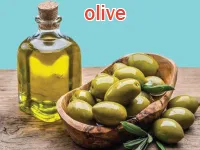
What is olive? Pronunciation and usage in English

olive means . Learn how to pronounce and use olive through vivid examples and easy-to-understand exercises.

Definition & pronunciation of olive

olivenoun

/ˈɒlɪv/
Definition & pronunciation of olive

Okay, let's break down how to pronounce "olive" in English. It's a tricky one for many learners! Here's a breakdown:

The most common and accepted pronunciation is:

  • /ˈɒlɪv/ (This is the IPA – International Phonetic Alphabet – representation)

Let's break that down:

  • ˈɒ – This is the stressed syllable. The “ɒ” sound is a short, open "o" sound, like in the word "hot" or "lot." It's not like the "o" in "open." It's kind of a rounded, slightly deeper "o."
  • l – The “l” sound is as you'd expect.
  • ɪ – This is a short “i” sound, like in "bit" or "sit."
  • v – The "v" sound.

Here's a more descriptive explanation:

Think of it like this: "OL-ihv" (but with a particular emphasis on the first syllable and a slightly different "o" sound).

Common Mispronunciations:

  • “Oh-live”: This is a very common mistake. It makes the "o" sound like in "open."
  • “Ol-eev”: Another frequent error, often adding an extra "e" sound.

Resources to help you hear it:

  • Google: Just type "pronounce olive" into Google and it will play an audio clip.
  • Forvo: https://forvo.com/word/olive/ This website lets you hear native speakers pronounce the word in different accents.
  • YouTube: Search for "how to pronounce olive" on YouTube for videos.

To help me give you even more tailored advice, would you like to:

  • Tell me what sound you are struggling with (e.g., the "o" sound)?

Usage and examples with the word olive in English

Let's break down how to use the word "olive" in English. It's a surprisingly versatile word with multiple meanings! Here's a detailed breakdown, categorized for clarity:

1. The Fruit - A Literal Olive

  • Definition: This is the primary meaning – the small, fleshy fruit of the olive tree, typically green, black, or purple.
  • Usage:
    • "I enjoyed a bowl of olives with my lunch."
    • "The farmer harvested a bumper crop of ripe olives."
    • "We bought a jar of Kalamata olives from the deli."
    • "She added sliced olives to her salad for a salty flavor."

2. The Tree - Olive Tree

  • Definition: The tree (Olea europaea) that produces olives.
  • Usage:
    • “The olive tree provides shade in the courtyard.”
    • “Olive groves are common in Mediterranean climates.”

3. Verb – To Olive (To Offer Peace or Apology)

  • Definition: This is the most interesting and less commonly used meaning. It means to offer or propose peace, reconciliation, or an apology. It’s a slightly formal and old-fashioned word.
  • Usage:
    • “The ambassador olived a peace proposal to the warring factions.” (Meaning he offered a proposal for peace).
    • "He olived his apologies after the misunderstanding." (Meaning he offered his apologies).
    • “The defeated general olived to his conqueror.” (Meaning he surrendered and offered peace).
  • Note: You’ll often see this used in historical or literary contexts.

4. Verb – To Olive (To Hide or Conceal – Less Common)

  • Definition: Less frequently, “olive” can mean to hide or conceal something, often something undesirable. This usage is becoming rarer.
  • Usage:
    • “She olived her mistakes behind to avoid embarrassment.” (Meaning she hid or concealed them).

5. Adjective – Olive-Colored/Green

  • Definition: Describing something that is olive green in color – a muted greenish-brown.
  • Usage:
    • “He wore an olive jacket.”
    • “The landscape had an olive hue.”
    • “She chose an olive lipstick shade.”

6. "Olive Branch" – Symbol of Peace

  • Definition: A branch adorned with olives, traditionally used as a symbol of peace and reconciliation. (This is a phrase, not a direct use of the word "olive.")
  • Usage:
    • “The signing of the treaty was a symbol of hope, like extending an olive branch to the people.”

Tips for Using "Olive" Correctly:

  • Context is key: Pay close attention to the context to determine which meaning is intended.
  • Formal Language: The verb “olive” (to offer peace) is a more formal word.
  • Don't overuse: Because it's a less common word, avoid using it too frequently.

Resources for Further Study:

To help me give you even more targeted advice, could you tell me:

  • In what kind of context are you trying to use the word "olive"? (e.g., writing a story, having a conversation, doing homework)

Practice with vocabulary olive

Exercise 1: Fill in the blanks

  1. The culinary workshop focused on the health benefits and versatile applications of ____ oil in various dishes.
  2. After intense negotiations, the two rival companies extended a metaphorical ____ branch, signaling a willingness to resolve their differences.
  3. The project manager emphasized the need for a collaborative approach, encouraging team members to achieve ____ through open communication.
  4. To ensure the quality of the new product line, the factory implemented stricter ____ standards for raw materials and finished goods.

Exercise 2: Choose the correct answer (there may be multiple correct answers per question)

  1. In the context of Mediterranean agriculture, which of these is cultivated primarily for its fruit and the oil extracted from it? a) Wheat b) Olive c) Grape d) Fig
  2. Which of the following is most commonly associated with a gesture of peace or reconciliation? a) A white flag b) An olive branch c) A handshake d) A peace treaty
  3. Which color is typically described as a deep, muted yellowish-green, often seen in military uniforms or nature? a) Teal b) Khaki c) Olive d) Forest green
  4. Which term best describes a formal understanding or agreement, often diplomatic, between two or more parties? a) Conflict b) Accord c) Contention d) Disagreement
  5. To effectively present a business proposal, one must ensure their arguments are well-supported and logically: a) Cohesive b) Disruptive c) Ambiguous d) Inconsistent

Exercise 3: Rewrite the sentences

  1. The designer chose a subtle, earthy green shade for the new office interiors to create a calming atmosphere.
    • Rewrite the sentence, incorporating a specific color term related to a fruit.
  2. After the major disagreement, the two departments made an effort to reconcile and work together again.
    • Rewrite the sentence to express the act of reconciliation using an idiomatic phrase.
  3. The team decided to end their ongoing dispute with a neighboring department by finding common ground.
    • Rewrite the sentence using a suitable replacement for "end their ongoing dispute".

Answer:

Exercise 1: Fill in the blanks

  1. The culinary workshop focused on the health benefits and versatile applications of olive oil in various dishes.
  2. After intense negotiations, the two rival companies extended a metaphorical olive branch, signaling a willingness to resolve their differences.
  3. The project manager emphasized the need for a collaborative approach, encouraging team members to achieve cohesion through open communication.
  4. To ensure the quality of the new product line, the factory implemented stricter quality standards for raw materials and finished goods.

Exercise 2: Choose the correct answer

  1. b) Olive
  2. a) A white flag, b) An olive branch, c) A handshake, d) A peace treaty
  3. c) Olive
  4. b) Accord
  5. a) Cohesive

Exercise 3: Rewrite the sentences

  1. The designer chose an olive green shade for the new office interiors to create a calming atmosphere.
  2. After the major disagreement, the two departments extended an olive branch to reconcile and work together again.
  3. The team decided to resolve their ongoing conflict with a neighboring department by finding common ground.

Comment ()