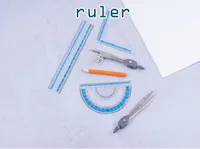
What is ruler? Pronunciation and usage in English

ruler means . Learn how to pronounce and use ruler through vivid examples and easy-to-understand exercises.

Definition & pronunciation of ruler

rulernoun

/ˈruːlə/
Definition & pronunciation of ruler

Okay, let's break down how to pronounce "ruler" in English. Here's a breakdown:

1. The Basic Sound:

  • "ru": This part sounds like "roo" as in the animal. Think of saying "roo" quickly and smoothly.
  • "ler": This part is a little trickier. It's pronounced like "luh" followed by a short "er" sound, similar to the "er" in "her" or "letter."

2. Putting it Together:

When you combine those two parts, it sounds like: "roo-luh"

3. Emphasis:

The emphasis is generally on the first syllable, “roo.”

4. A Quick Tip:

Imagine you're saying “roo” and then quickly adding “luh”.

Resources for Hearing it:

  • Google Search: Simply type "how to pronounce ruler" into Google, and it will often have audio playback.
  • Forvo: https://forvo.com/word/ruler/ - This website has pronunciations from native speakers.

Do you want me to:

  • Repeat the pronunciation slowly?
  • Give you another example word to practice with?

Usage and examples with the word ruler in English

Let's break down how to use the word "ruler" in English. It has a few different meanings, so it's important to understand the context!

1. The Physical Ruler (Measuring Tool)

  • Definition: This is the most common meaning. A ruler is a small, straight tool used for measuring lengths. It usually has markings along its edge to indicate inches, centimeters, or other units.
  • Examples:
    • "I need a ruler to measure this book."
    • "Can you pass me the ruler?"
    • "She used a ruler to draw a straight line."
    • "The carpenter used a steel ruler for precision."

2. A Person in Charge (Historically)

  • Definition: Historically, a "ruler" was a person who governed a country, kingdom, or other territory. This meaning is less common in everyday conversation now, but you'll encounter it in history, literature, and formal contexts.
  • Examples:
    • "The ruler of England issued a new decree." (Referring to the monarch)
    • "Ancient Egypt was ruled by pharaohs."
    • "The ruler oversaw the construction of the palace."

3. (Figurative) A Person with Authority or Influence

  • Definition: Less directly, “ruler” can be used metaphorically to describe someone who holds a position of power or influence, even if they aren’t a formal leader.
  • Examples:
    • "She’s the ruler of the dance floor, always knowing how to get people moving." (She is the most popular and influential dancer.)
    • "He’s a ruler in the tech industry." (He's highly influential and respected.)

Key Phrases & Related Words

  • To rule: This verb means "to govern" or "to control." Example: "The king ruled his kingdom wisely."
  • Rule of thumb: (Idiom) A rough or approximate guideline. Example: "A good rule of thumb is to wait 15 minutes after eating before taking medication."
  • Rule book: (Noun) A set of rules or regulations. Example: “The team followed the coach’s rule book carefully.”

To help me give you even more targeted information, could you tell me:

  • What are you trying to do with the word "ruler"? (e.g., are you writing a story, having a conversation, doing homework?)
  • What context are you using it in? (e.g., Are you talking about measuring something, history, or something else?)

Practice with vocabulary ruler

Exercise 1: Fill in the blanks

  1. For precise architectural drawings, an engineer often relies on a ______ to ensure all lines are perfectly straight.
  2. Historically, the ______ of an empire held ultimate authority, often dictating laws and leading military campaigns.
  3. Before cutting the fabric, please carefully ______ the dimensions to avoid any waste.
  4. The newly appointed ______ quickly implemented several reforms aimed at improving the city's infrastructure and public services.

Exercise 2: Choose the correct answer

  1. Which of these instruments would you typically use to draw a straight line or measure a short distance in a geometry class? a) Protractor b) Compass c) Ruler d) Calipers
  2. In a historical context, which term describes a person holding supreme power, often hereditarily, over a kingdom or empire? a) President b) Premier c) Ruler d) Chancellor
  3. If you are asked to "measure with a ruler," which of the following tasks could you perform? (Select all that apply.) a) Determine the exact angle of a triangle. b) Calculate the volume of a liquid. c) Draw a straight edge for a presentation board. d) Ascertain the length of a desk.
  4. When designing a detailed circuit board, engineers use a ______ to accurately determine the spacing between microscopic components. a) template b) caliper c) schematic d) protractor
  5. Which individuals typically possess ultimate governing authority within a state or organization? (Select all that apply.) a) Subordinate b) Sovereign c) Autocrat d) Representative

Exercise 3: Rewrite the sentences

  1. I need something with a straight edge to mark this line on the blueprint.
  2. The kingdom thrived under the guidance of its monarch for several decades.
  3. The person in charge of the province made several unpopular decisions that led to public protests.

Answer:

Exercise 1: Fill in the blanks

  1. For precise architectural drawings, an engineer often relies on a ruler to ensure all lines are perfectly straight.
  2. Historically, the ruler of an empire held ultimate authority, often dictating laws and leading military campaigns.
  3. Before cutting the fabric, please carefully measure the dimensions to avoid any waste.
  4. The newly appointed governor quickly implemented several reforms aimed at improving the city's infrastructure and public services.

Exercise 2: Choose the correct answer

  1. c) Ruler
  2. c) Ruler
  3. c) Draw a straight edge for a presentation board. d) Ascertain the length of a desk.
  4. b) caliper
  5. b) Sovereign c) Autocrat

Exercise 3: Rewrite the sentences

  1. I need a ruler to mark this line on the blueprint.
  2. The kingdom thrived under its ruler for several decades.
  3. The governor of the province made several unpopular decisions that led to public protests.

Comment ()